

The order matters
After a break-in, everything feels urgent at once. Doing things in the right order protects your safety, your insurance claim and your home, in that priority.
1. Safety first
If you arrive home and something is wrong — a door open, a broken window, a light on that shouldn’t be — do not go in. Intruders are occasionally still inside, and no possession is worth meeting one.
Stay outside, go to a neighbour or sit in your car with the doors locked, and ring 112 or 999.
If you’re already inside when you realise, leave and ring from outside.
2. Report it to the Gardaí
Report the break-in and get the report number. Your insurer will ask for it, and without a report a claim becomes much harder.
The Gardaí may want to attend before anything is moved, particularly if there’s forensic potential — a point of entry that’s been handled, tool marks, or property taken. Ask whether you should wait before touching anything.
3. Photograph everything before you tidy
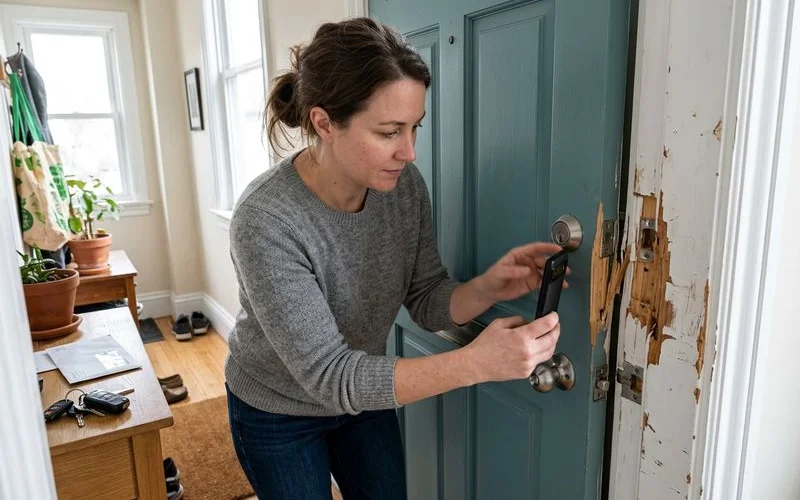
This is the step people skip, and the one they regret.
Photograph:
- The entry point — the door, window or frame, wide and close up.
- The damaged lock or mechanism, including any snapped cylinder.
- Splintered timber, bent keeps and damaged strike plates.
- Each affected room before anything is put back.
- Missing items — a photo of the empty space where something was is genuinely useful.
Photos taken before repairs are evidence. Photos taken after are a description.
4. Get the property secure
Now the locksmith. Ring, describe what’s damaged, and we’ll tell you whether it’s a lock replacement, a frame repair or a boarding-up job.
Break-in calls are priority work in our burglary and break-in repair service, 24 hours a day. Nobody should spend a night in a house that can’t be locked.
Where the damage is too severe for a lock to re-secure it — a shattered panel, a door off its hinges, broken glazing — emergency boarding-up closes the property tonight so a proper repair can happen in daylight.
5. Repair properly, and fix the weak point
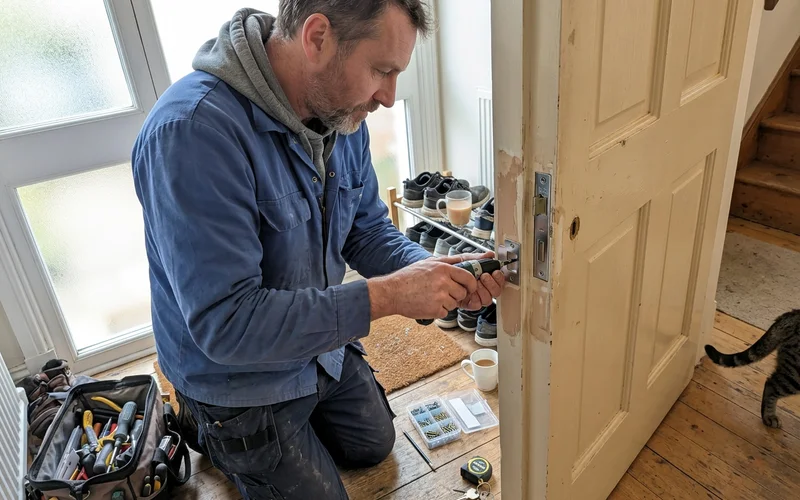
Two parts to this.
The repair itself. Forced entry usually splinters the frame around the keep, and fitting a new lock into damaged timber achieves very little. The frame needs repairing, fixings need to reach solid material, and the strike plate often needs upgrading.
The weak point. Most forced entries exploit one specific failure. If the cylinder was snapped, every other standard cylinder in the house is equally vulnerable. If the frame gave way, the other doors may have the same fixings. Ask what actually failed, and deal with it while someone is already there.
6. Documentation for your claim
Ask your locksmith for a written record of the work: what was fitted, on which doors, to which standard, and when. Keep it with your Garda report number, your photographs and the receipts.
That bundle is what makes a claim straightforward. Our guide on meeting insurance requirements after a burglary covers what insurers typically look for.
Afterwards
Two things worth doing in the following week, when the immediate pressure has passed.
Review the other doors. The back, the side, the patio, the garage. Security follows the weakest point, and it’s rarely the door that was just repaired.
Talk to someone. A break-in is an intrusion into the place you’re supposed to feel safest, and feeling unsettled in your own home afterwards is an entirely normal reaction, not an overreaction. Getting the locks sorted properly helps more than people expect, precisely because it’s the concrete part of the problem you can actually fix.